



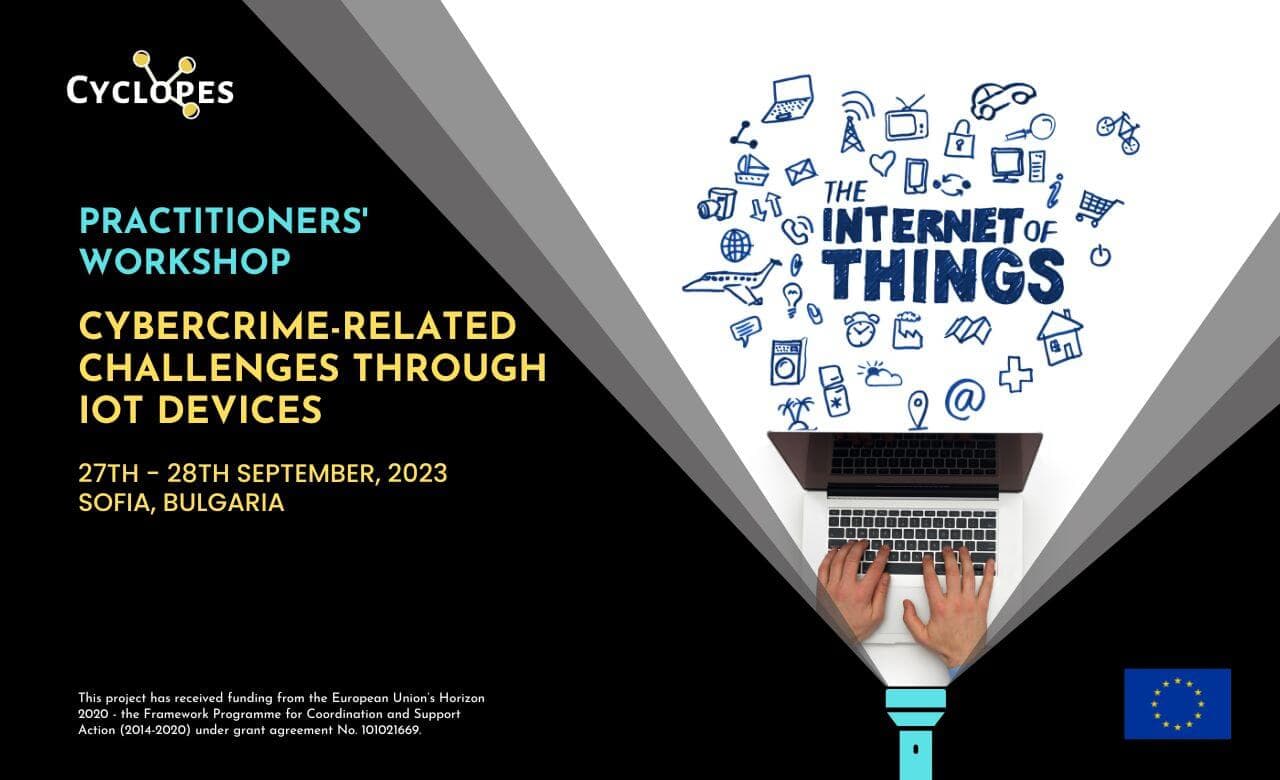
CYCLOPES Practitioner Workshop: Internet of Things (IoT) Devices


The next CYCLOPES practitioners’ workshop, will be delivered as a face-to-face event (with no option for remote participation) in Sofia, Bulgaria on 27th and 28th September 2023.
Our hosts for the event will be the Bulgarian Ministry of Interior at their GDCOC premises.
The subject of the workshop will be ‘Internet of Things (IoT) Devices’ and we will over the duration of the workshop explore the challenges practitioners working with this field are facing in their operational activities, as well as seeking to identify the common priorities that can be used to inform future engagements with academia and industry to deliver solutions. A more detailed scope of the workshop can be found in the attached Practitioners’ Handbook in section 3.
Background
Digital forensics of IoT devices is an increasingly important topic in today’s connected world and is becoming more relevant in crime investigations. With the growing number of IoT devices used in our everyday lives, it is vital that law enforcement agencies are able to include these devices in the recovery and evaluation process. Digital forensics plays an important role in extracting and analysing potentially relevant data from IoT devices.
The term IoT refers to physical objects or “things” and the networking of these physical objects and devices with other devices or systems over the Internet. IoT devices are hardware devices, such as smartphones, smart home devices, wearables, connected cars or smart cities for example. While performing various tasks in our everyday lives, these devices collect, exchange and process a variety of data, including personal information, location data, and communication data. This type data has the potential to be misused for criminal activities, such as identity theft, fraud, or espionage.
To conduct a forensic investigation of IoT devices, specialised tools and techniques must be available to law enforcement agencies. These tools allow forensic investigators to extract, analyse and interpret data from the devices. In doing so, they must ensure that the integrity of the data is maintained and that no changes are made to the digital evidence extracted from these IoT devices.
A major challenge for law enforcement agencies is the variety of different IoT devices and their operating systems, as well as the constant and fast evolution and innovations in the field. Each device could have a different operating systems and software versions, making forensic investigation more complex. Forensic experts must therefore build and constantly expand their in-depth knowledge and experience of these different devices and systems.
Overall, digital forensics of IoT devices is a complex and important area that requires thorough investigation and analysis. It is critical that forensic scientists or practitioners have the necessary expertise and tools to conduct an effective forensic investigation. This is the only way to detect crimes and identify criminals. It is important for law enforcement agencies to continuously stay up-to-date and remain familiar with ever-evolving technologies.
The CYCLOPES practitioner workshop “Smart Home: Discovery, detection, collection, examination and analysis of IoT devices” provides an opportunity and platform to discuss and evaluate how we as law enforcement agencies (LEAs) access and utilise data from IoT devices to aid investigations. We will explore the state of play from different participating LEAs, what problems investigators face regarding the acquisition and decoding of data, and the needs of LEAs concerning technology, legislation and standardisation.
The objectives of this workshop are to:
- List the most common IoT devices analysed and which might be relevant in the future
- List the key technologies and techniques used by LEAs in investigations involving IoT devices
- Identify limits and concerns with the technologies and methods currently used for IoT investigations
- Identify key legislative challenges surrounding investigations involving IoT devices
- Develop common areas for innovation and requirements for standardisation in the field of investigations involving IoT devices
Participation
We are now seeking practitioners to attend the workshop who have a thorough working knowledge of the subject and can present their experiences in discussions with other practitioners from across European LEA’s. Participants will be expected to deliver a short presentation on a pre-defined template (coming soon) that covers their current working practices and future requirements. The pre-workshop activities can be found at section 6 in the handbook which includes information on the survey. The official working language of the project is English, so participants should be able to have a working knowledge of the language in order to participate. Please note that this workshop is only for Law Enforcement practitioners and not for commercial partners.
The programme for the workshop will be:
-26th September – arrival in Sofia, Bulgaria
-27th September – workshop 09:00 – 17:00
-28th September – workshop 09:00 – 12:00; departure after 12:00
There will also be an optional social programme for participants on the evening of 27th September.
To register suitable candidates within your organisation (max. 1-2 participants per organisation) for this event, please forward their details and provide the presentation (using the pre-defined PPTX template) to Claudia and Meera from the Home Office (claudia.telfer@homeoffice.gov.uk and meera.barnett@homeoffice.gov.uk) no later than Monday, 4th September 2023. We would be grateful if you could also provide a few lines outlining the nominated participants current role and experience.
Due to a limited number of places, please DO NOT book your travel or accommodation until we have confirmed your place and registration.
In addition, we plan to organise 1 hour online meeting to inform everyone about the scope of the workshop and answer for all kind of questions related to the workshop. The meeting will be held on 8th September and we will send more details in the coming days.
Documents related to this event
The term IoT refers to physical objects or “things” and the networking of these physical objects and devices with other devices or systems over the Internet. IoT devices are hardware devices, such as smartphones, smart home devices, wearables, connected cars or smart cities for example. While performing various tasks in our everyday lives, these devices collect, exchange and process a variety of data, including personal information, location data, and communication data. This type data has the potential to be misused for criminal activities, such as identity theft, fraud, or espionage.
A major challenge for law enforcement agencies is the variety of different IoT devices and their operating systems, as well as the constant and fast evolution and innovations in the field. Each device could have a different operating systems and software versions, making forensic investigation more complex. Forensic experts must therefore build and constantly expand their in-depth knowledge and experience of these different devices and systems.
The CYCLOPES practitioner workshop “Smart Home: Discovery, detection, collection, examination and analysis of IoT devices” provides an opportunity and platform to discuss and evaluate how we as law enforcement agencies (LEAs) access and utilise data from IoT devices to aid investigations. We will explore the state of play from different participating LEAs, what problems investigators face regarding the acquisition and decoding of data, and the needs of LEAs concerning technology, legislation and standardisation.

